Material selection is the first engineering decision in a high performance interconnect, and it sets everything that follows: contact resistance and signal integrity at frequency, mechanical reliability under shock and vibration, magnetic behavior near sensitive instrumentation, and how the assembly holds together at cryogenic temperature.
Every Fuzz Button® contact and custom interposer we build starts with that decision. We specify the wire alloy and the carrier material against your operating environment rather than against a fixed catalog, which is why the same fine pitch interconnect geometry gets built very differently for a dilution refrigerator than it does for an airborne radar assembly.
Gold Plated Beryllium Copper (Au/BeCu)
Au/BeCu is our standard wire material and the right answer for most RF, board to board, and high density interconnect applications. Beryllium copper supplies the spring memory that gives a fuzz button its compliance and its consistent mating force. The gold plating keeps contact resistance low and stable through thermal cycling and repeated mating.
Available with or without a nickel barrier layer under the gold. See Non-Magnetic Plating below.
Typical applications:
- RF coaxial interconnects
- Solderless interconnect assemblies
- BGA and PCB interposers
- Board to board interposers
- General fine pitch interconnect work
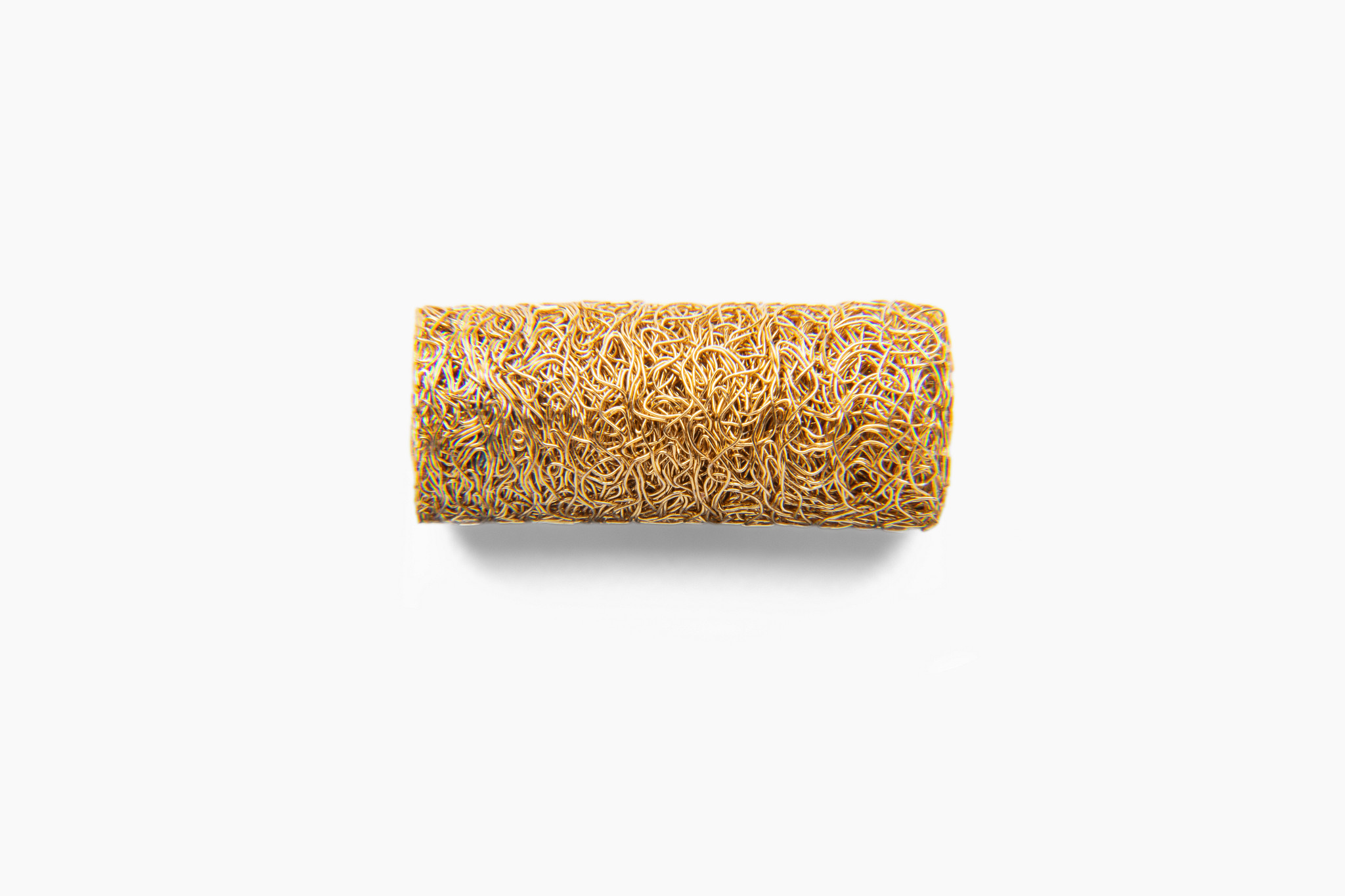
Gold Plated Molybdenum (Au/Mo)
Au/Mo is specified when the design calls for higher current density or tight dimensional stability across a wide temperature range. Molybdenum has a very low coefficient of thermal expansion, so contact geometry and mating force stay predictable as the assembly cools instead of drifting with the surrounding structure. That property is the reason Au/Mo shows up in almost every cryogenic interconnect we build.
Also available with or without a nickel barrier layer under the gold, which makes Au/Mo the usual starting point for cryogenic work that also has a permeability limit.
Typical applications: cryogenic interconnect and cryogenic PCB interposer assemblies, superconducting qubit and ion trap packaging, dilution refrigerator stages, high current density designs.
Non-Magnetic (Nickel Free) Plating
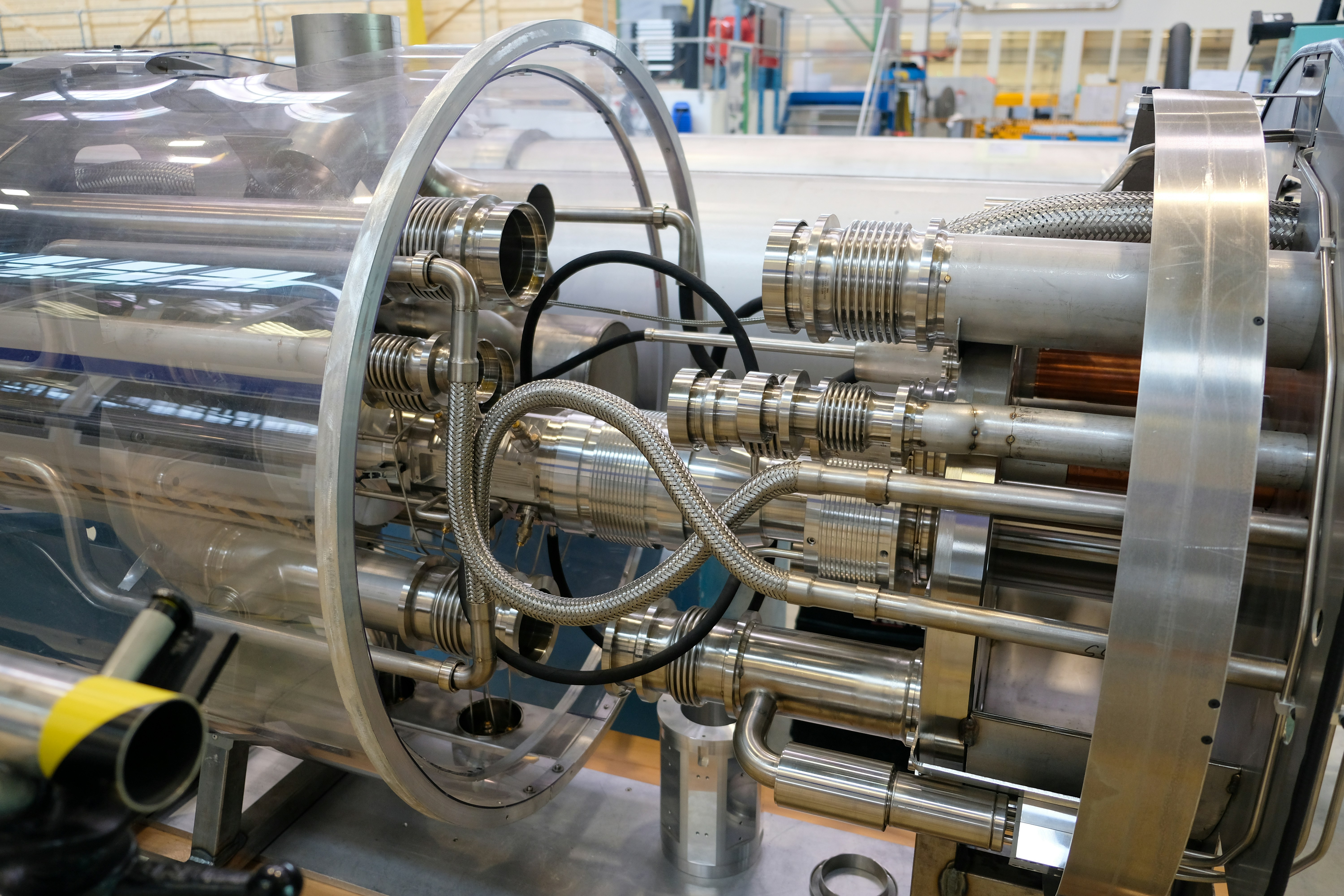
Magnetic permeability matters in quantum computing and precision instrumentation, where a stray magnetic signature near the sample stage corrupts measurement before it ever reaches the signal path.
Standard gold plating puts a nickel barrier layer underneath the gold, and that nickel is the magnetic element in an otherwise non-magnetic contact. We remove it. Both Au/BeCu and Au/Mo fuzz buttons are available with nickel free gold plating, which produces a non-magnetic contact without changing the wire alloy or the contact geometry, so the density and compliance that make the technology worth using are preserved.
Tell us the permeability limit your program is working to and we will plate to it.
Development and Program Specific Wire Materials
Some programs need a wire material outside the standard set, most often in quantum, space, and extreme environment work. We take these on as engineering programs rather than catalog orders.
- Molybdenum rhenium (MoRe), for temperature range, ductility and radiation tolerance
- Niobium and niobium titanium (NbTi), for superconducting applications where signal has to enter the circuit without a resistive discontinuity at the interface
- Tantalum and vanadium, both superconducting below their critical temperature
- Pure aluminum, superconducting at the low end of the temperature range
- Unplated molybdenum and unplated beryllium copper, where the gold layer is not wanted
If your design depends on one of these, start the conversation early and bring the operating temperature, the critical current requirement, and the mating interface.
Carrier and Interposer Body Materials
The carrier holds the contacts in position and sets the dielectric environment they operate in. It is as much of a performance decision as the wire. The materials below are the ones we work in most often. They are not a limit. If your program specifies a different body material, we will build in it.
| Material | Where it fits |
|---|
| PTFE | PTFE has the lowest dielectric loss of the carrier materials we work with, which makes it the default for RF and microwave interconnects where insertion loss and impedance control govern the design. We also build Fuzz Button® contacts inside PTFE insulated sleeves, a configuration that holds RF integrity through the transition and is one of the most requested builds from high frequency interconnect designers. |
|---|
| PEEK® | PEEK holds its mechanical and dimensional properties at elevated temperature and resists most process chemistries, which makes it a practical carrier where the assembly sees thermal excursions or aggressive cleaning between cycles. |
|---|
| Ultem® (PEI) | Ultem combines dimensional stability with good dielectric performance and the flame, smoke and toxicity behavior that airborne electronics programs require. It is a common choice across cryogenic, high current and high density builds. |
|---|
| Torlon® (PAI) | Torlon has the highest structural strength of the machinable plastics we use and the best creep resistance under sustained load. It is what we reach for when the carrier itself becomes the limiting element, which happens on thin wall designs and on the highest position count interposers. |
|---|
| FR4 and G10 | Glass reinforced epoxy laminates, dimensionally stable, well understood by every PCB designer, and economical at larger panel sizes and higher position counts. FR4 and G10 are common interposer bodies where the assembly does not need the temperature range or the dielectric performance of a machinable plastic. |
|---|
| Aluminum and Brass | Metal bodies are used where the carrier also has to serve as a ground and shield, or where the interposer has to carry structural or thermal load. Each contact is isolated within the body, typically in a PTFE sleeve. |
|---|
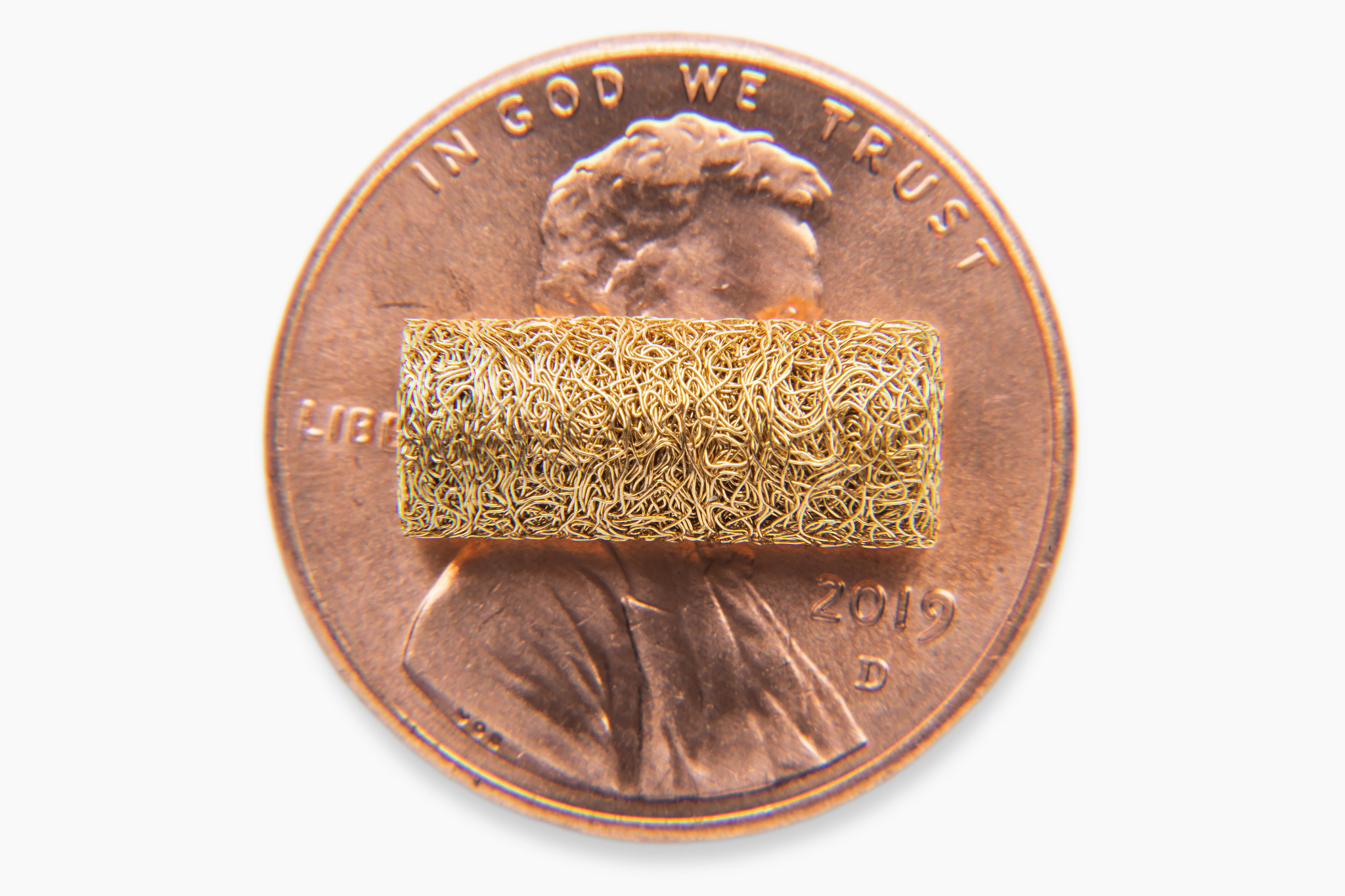
Development Carrier and Body Materials
We regularly build prototypes in materials outside the standard set, including CVD diamond, Dyna-Cool, silicon, Shapal, Macor, MDS 100 and Vespel.
If your program calls for something not on this page, send it to us. We will work in whatever material your design requires.
Material Selection Guide
These are common pairings. Most programs need something in between, and that is what we work out with you.
| Application | Wire material | Carrier or body | Why |
|---|
| Quantum and cryogenic | Au/Mo, nickel free | Ultem®, FR4, G10 | Non-magnetic contact and dimensional stability through cooldown |
|---|
| RF and microwave | Au/BeCu | PTFE | Lowest dielectric loss and impedance control, PTFE sleeve option available |
|---|
| Aerospace and defense, high shock and vibration | Au/BeCu | PTFE | Spring memory and signal integrity under shock and vibration |
|---|
| High current | Au/Mo | FR4, Ultem® | Current handling with a dimensionally stable body |
|---|
| High density interposers | Au/BeCu | FR4, Ultem® | Fine pitch and high position count in a stable, economical body |
|---|
| Satellite and space | Au/Mo | PTFE | Temperature range and stability where the assembly cannot be serviced |
|---|
This table is a starting point, not a limit. We are not restricted to these materials, and we will build an interposer in whatever body material your program specifies.
Get in touch
Not sure which material is right for your environment? Send us the operating conditions, the position count and the envelope. We will specify the stack.
Request an Engineering Consultation